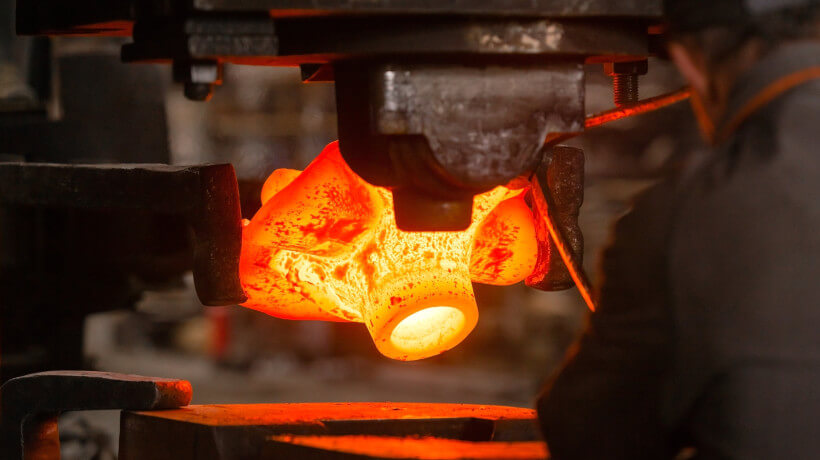





| High-temperature processing is essential in modern manufacturing. From heat treating and forging to annealing and brazing, elevated temperatures are necessary to achieve desired mechanical properties and structural performance. However, these processes also introduce significant risks to material integrity. Two of the most common and costly surface-related issues are oxidation and decarburization. At Advanced Technical Products, we work with manufacturers who rely on consistent metallurgical results. We understand that controlling oxidation and decarburization is not just about surface appearance. It is about protecting strength, maintaining dimensional tolerances, and ensuring long-term component performance. That is why we develop and apply specialized protective coatings that control oxidation and decarburization during high-temperature processing. Understanding Oxidation in High-Temperature Environments Oxidation occurs when metal surfaces react with oxygen at elevated temperatures. During heat treatment or furnace exposure, oxygen present in the atmosphere interacts with the metal, forming oxide layers commonly referred to as scale. This scale formation can cause: Surface roughness and pitting Loss of dimensional precision Increased post-process cleaning or machining Reduced corrosion resistance Lower surface quality for subsequent finishing operations In severe cases, oxide scale can penetrate deeper into the material surface, requiring additional material removal and increasing scrap rates. For precision components, even minor oxidation can lead to unacceptable variations. The higher the temperature and the longer the exposure time, the greater the risk of oxidation. In processes such as forging, carburizing, and hardening, oxidation is often unavoidable without proper surface protection. Understanding Decarburization and Its Metallurgical Impact Decarburization is more subtle but equally damaging. It occurs when carbon diffuses out of the surface of steel during high-temperature exposure in an oxidizing atmosphere. Because carbon is a key element responsible for hardness and strength in many steel grades, its loss significantly alters mechanical properties. The consequences of decarburization include: Reduced surface hardness Lower fatigue strength Compromised wear resistance Increased risk of cracking or premature failure Unlike oxidation, decarburization may not always be visible. A component may appear acceptable but fail under load because its hardened surface layer has been depleted. For industries such as aerospace, automotive, and heavy equipment manufacturing, decarburization can undermine the performance of gears, shafts, springs, and structural components. Why Surface Protection Must Be Engineered, Not Improvised Some manufacturers attempt to control oxidation and decarburization through furnace atmosphere adjustments alone. While controlled atmospheres can help, they are not always practical or sufficient. Furnace leakage, temperature gradients, and inconsistent atmospheric control can still allow oxygen infiltration. Protective coatings provide an additional and often more reliable barrier between the metal surface and the surrounding environment. At Advanced Technical Products, we engineer coatings that: Create a physical barrier to oxygen and reactive gases Withstand high temperatures without degrading Maintain adhesion during thermal expansion and contraction Protect surface carbon content during exposure This barrier approach ensures the base material remains intact even when furnace conditions fluctuate. How Protective Coatings Function During Heat Treatment Protective coatings act as sacrificial or barrier layers. When applied correctly, they isolate the substrate from oxygen and carbon-depleting reactions. During heating: 1. The coating forms a stable protective layer. 2. Oxygen cannot easily penetrate to the metal surface. 3. Carbon diffusion is limited or prevented. 4. The underlying metal retains its intended chemical composition. Because the coating absorbs or blocks reactive exposure, the substrate remains protected throughout the heating cycle. After processing, coatings can often be removed or cleaned without damaging the part surface, leaving a protected, scale-free component. Reducing Post-Processing Costs Surface oxidation and decarburization often require secondary operations such as grinding, machining, blasting, or chemical cleaning. These additional steps increase labor, extend production timelines, and reduce overall yield. By preventing surface damage at the source, protective coatings help manufacturers: Reduce rework and scrap Improve throughput Maintain tighter tolerances Lower total cost per part In high-volume operations, these savings become substantial over time. Supporting Dimensional Stability High-temperature exposure can already introduce thermal distortion. When oxidation and scale removal are added to the equation, dimensional stability becomes even more difficult to maintain. Protective coatings help preserve surface geometry by preventing material loss. This is particularly important for: Precision machined components Gears and splines Tooling and dies Aerospace structural parts By preserving the original surface profile, coatings reduce the need for corrective machining and maintain part integrity. Industry Applications Our protective coatings are used across industries where high-temperature processing is routine: Aerospace components requiring tight hardness control Automotive drivetrain parts subject to heat treatment Industrial tooling exposed to repeated furnace cycles Forged components where surface finish matters In each application, maintaining surface chemistry is critical to ensuring performance and safety. Engineering Surface Protection With Precision At Advanced Technical Products, we treat protective coatings as engineered solutions rather than generic treatments. Each application requires evaluation of: Base material composition Maximum processing temperature Dwell time Furnace atmosphere Post-processing requirements By understanding these variables, we apply coatings that align precisely with operational demands. Protecting Performance From the Surface Inward Oxidation and decarburization do not just affect appearance. They compromise mechanical integrity from the surface inward. Protective coatings provide a reliable method for preserving surface chemistry, hardness, and dimensional stability. Through our specialized protective coatings that control oxidation and decarburization, we help manufacturers maintain material integrity, reduce rework, and achieve consistent results in high-temperature processing. When surface protection is engineered correctly, quality becomes predictable and performance remains uncompromised. |
25
Feb
2026